Every organization that wants to increase the efficiency of its HR operations must invest in HR Management Systems. This system can automate hiring, onboarding, performance management, and keeping track of personnel data, saving more time and reducing mistakes. Business leaders constantly demand to increase productivity, reduce costs, and increase customer satisfaction.
Hence, effective HR management is essential for any firm's success in the recent competitive business world. Here is a list of several advantages and reasons for investing in HR Management software that could help in the growth and success of your business:
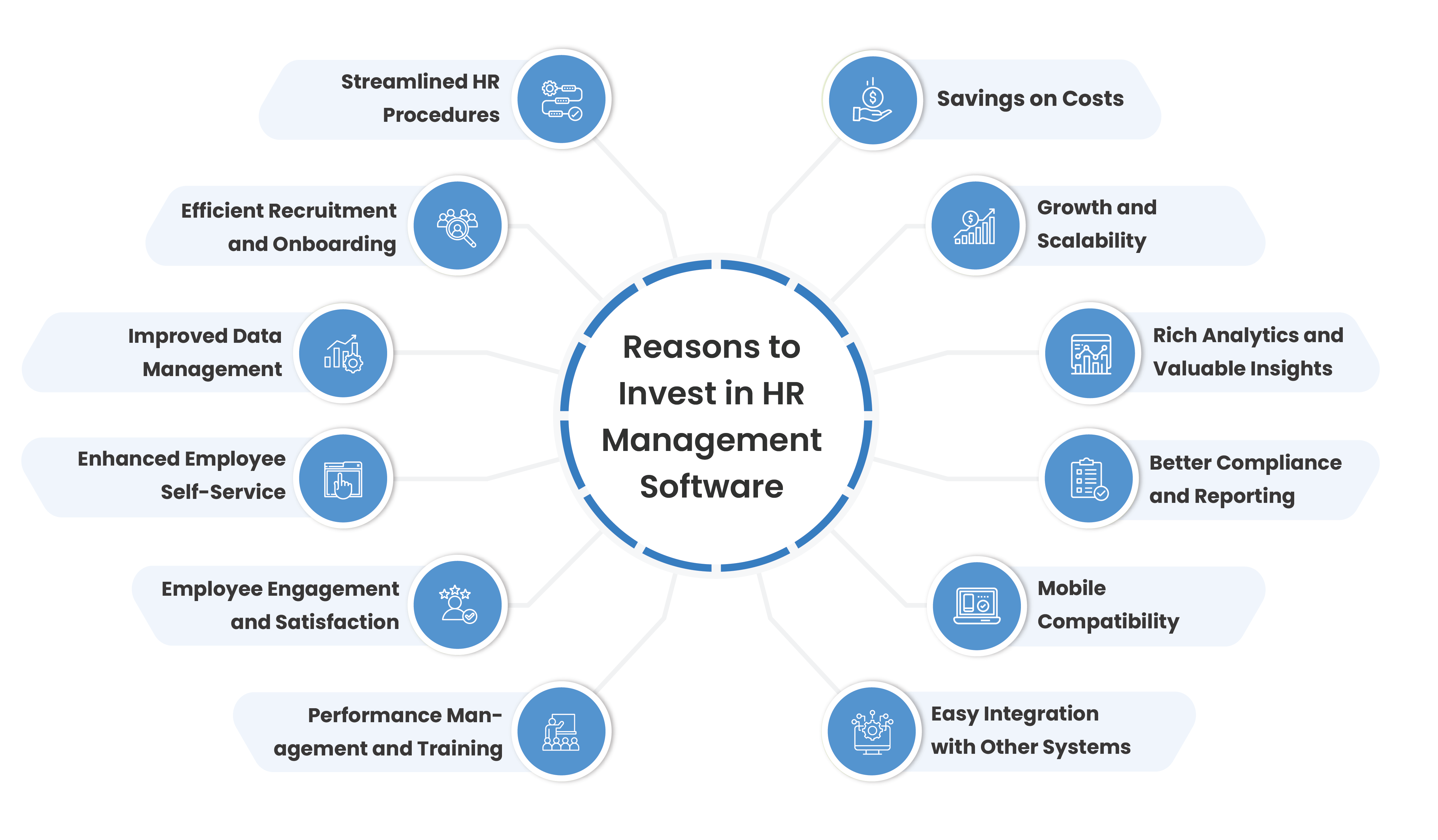
Streamlined HR Procedures
Efficient Recruitment and Onboarding
Improved Data Management
Enhanced Employee Self-Service
Employee Engagement and Satisfaction
Performance Management and Training
Savings on Costs
Growth and Scalability
Rich Analytics and Valuable Insights
Better Compliance and Reporting
Mobile Compatibility
Easy Integration with Other Systems
Streamlined HR Procedures
HR management software helps you automate and simplify numerous HR operations. It includes employee onboarding, attendance tracking, leave management, performance evaluations, and payroll processing. In addition to saving time and eliminating lengthy paperwork, this increases productivity.
HR software speeds up the hiring and onboarding process by automating the advertising of job openings, applicant tracking, resume screening, scheduling of interviews, and new hire paperwork. It enables HR teams to interact more effectively, assess applicants quickly, and give new hires a great onboarding experience.
Businesses can save and manage employee data in a centralized system with the help of HR software. It thus simplifies accessing, updating, and analyzing employee information, including personal information, employment history, training records, and performance statistics. Accurate and up-to-date data enables informed decision-making and assures compliance with legal and regulatory obligations.
Employee self-service portals are a common feature of modern HR software, allowing staff members to handle their HR-related duties. Employees have access to and may revise their personal information, enroll in benefits, examine their pay stubs, request time off, and review pertinent HR regulations and documentation. This self-service functionality lessens the administrative workload for HR professionals and increases employee satisfaction.

The HR management system can help you contribute to higher employee engagement and satisfaction levels. Automating administrative tasks gives employees more time to concentrate on meaningful work and career growth. Employees may use self-service portals to easily access information and conduct HR-related duties, which improves their overall experience.
HR management software usually includes performance management features that can help facilitate goal setting, performance reviews, feedback collection, and performance monitoring. It also helps in determining training requirements and skill gaps. By centralizing these procedures, company executives may enhance employee performance, recognize top performers, and support initiatives for professional growth.
Implementing HR management software requires an initial investment, but it may result in long-term cost benefits for business enterprises. Business owners may save administrative expenses and distribute resources more effectively by automating routine HR processes, minimizing paperwork, and lowering mistakes. Additionally, enhanced data quality and simplified procedures could prevent prohibitively expensive compliance concerns or monetary penalties.
Managing manual HR activities and operations becomes more challenging as organizations develop and the workforce grows. Scalability in HR management software enables business authorities to manage a bigger employee base and does not compromise efficiency. It can adapt to ever-shifting organizational demands, allowing remote work arrangements and supporting worldwide operations.
HR software includes reporting and analytics features that give useful insights regarding workforce trends, employee performance, attrition rates, and other HR metrics. Company executives or HR managers may use these analytics to locate areas for improvement, optimize resource allocation, and make data-driven decisions. Additionally, it supports talent acquisition, strategic workforce planning, and succession planning.
HR software supports the firms in complying with labor laws and regulations by automating compliance-related operations like invoice tracking, GST billing accruals and tax computations. Additionally, it creates reports and analytics on HR indicators, employee turnover, diversity, and other relevant data, simplifying strategic planning and allowing for well-informed decision-making.
Several HR management software options provide mobile apps or mobile-friendly interfaces. It allows HR personnel and employees to access HR-related details on the go. This accessibility is especially useful for remote workers, field staff, or those who regularly travel because they can easily perform HR operations using their smartphones or tablets.
Human resource management software often integrates with other operations or systems such as payroll, time and attendance monitoring, and employee benefits management. This interface eradicates the requirement for manual data input and maintains data consistency across several platforms. It also presents a comprehensive overview of staff information, enabling smooth cross-functional collaboration and data transfer.