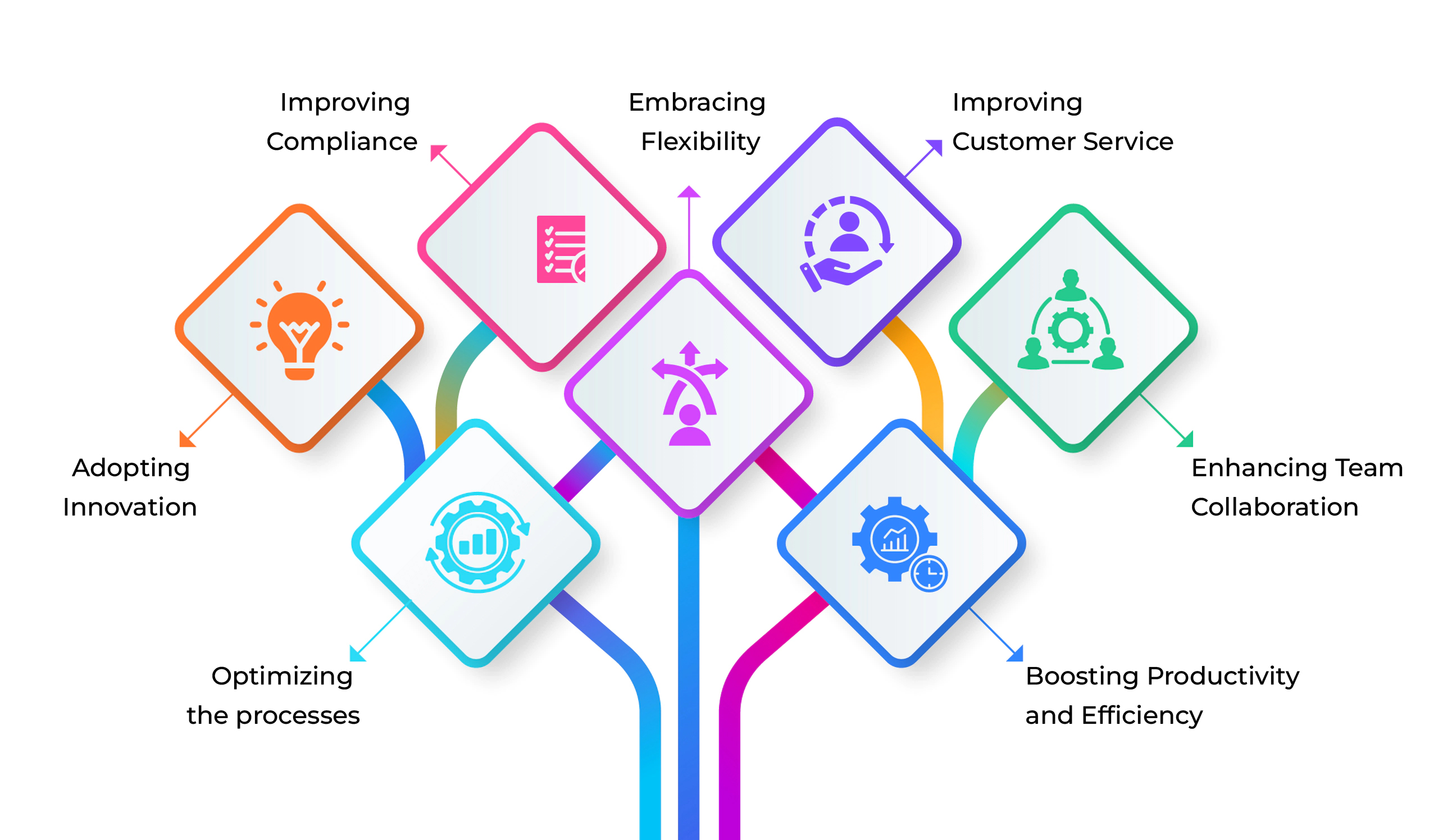
Business process management is the key to achieving digital transformation in an organization. It gives businesses a means of managing their internal processes and enhancing factors, such as
BPM is essential for optimizing business processes to increase efficiency, productivity, and quality. It enables businesses to find process errors, inefficiencies, and redundancies in operations and create solutions to address them. By automating business processes and minimizing repetitive tasks, BPM lowers costs and cycle duration while enriching accuracy and compliance. Therefore, it leads to increased productivity and decreased errors.
BPM provides a comprehensive approach to innovation and transformation. BPM assists organizations in developing innovative strategies that elevate business advancement and competitiveness. By analyzing existing procedures, it recognizes opportunities for improvement. Further, BPM establishes a structure for ongoing process improvement. So, it allows management to stay ahead of their competitors and achieve long-term success.
In today's digital world, organizations face more challenges in maintaining compliance. Accordingly, they must enhance their compliance processes and encounter these difficulties to stay competitive. Business Process Management (BPM) is required to accomplish this. Businesses can improve business process management by automating and simplifying their processes. That will help them manage their compliance processes more effectively.
- Boosting Productivity and Efficiency
Business process management (BPM) enables organizations to design more effective and efficient procedures than their existing ones. It frequently entails identifying and eliminating inefficiencies and tedious tasks in current operations. Besides, BPM can streamline business processes so that different departments use standardized methods, saving time and money. It can also boost productivity and efficiency within departments.
- Improving Customer Service
A firm's success increasingly depends on the customer experience in the modern digital age. BPM offers a structured approach to customer engagement and service delivery, which supports firms in becoming more customer-oriented. Likewise, it affects their brand perception among customers. That is why modern BPM technologies enhance the customer experience while cutting costs. With the help of BPM, businesses can design and implement client-focused processes and constantly better them based on customer response and feedback.
Organizations must be flexible and agile with digital transformation. That responds to changing business demands. BPM helps firms react fast to shifting market conditions by delivering a structured approach to process design, analysis, and improvement. BPM also supports organizations in handling risks and uncertainties by building a framework for continuous process evaluation and enhancement.
- Enhancing Team Collaboration
Collaboration and communication across departments and functions are fundamental for digital transformation. Organizations can use BPM to break down communication barriers and boost team collaboration. BPM provides a universal language and system for designing and improving processes. And allow the teams to work together more efficiently and successfully.